
Network rollout tracked in one workspace. Not scattered across email and spreadsheets.
From the first site candidate to the final acceptance test, your rollout teams, vendors and contractors work from a single source of truth. Delays surface early, nothing falls through, and the as-built record you finish with is one your operations team can actually trust.
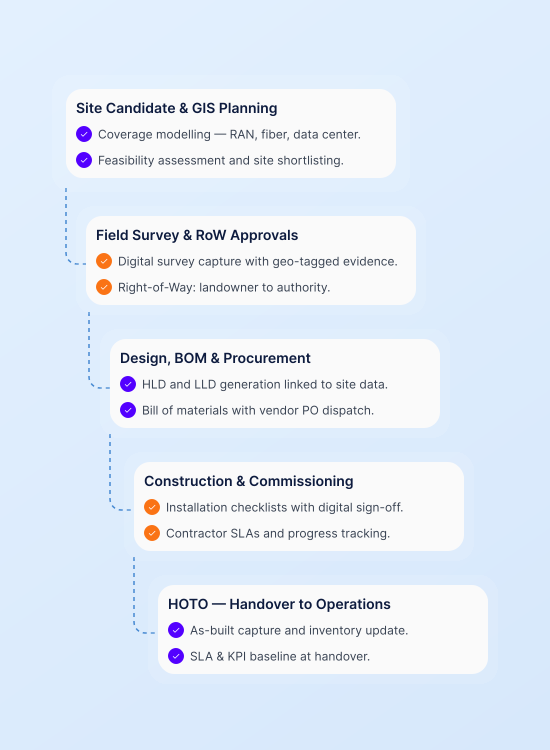
The schedule is not the problem.
The handoffs are.
Every rollout stage produces data the next stage needs, and in most programmes that data travels by attachment. A design lands in a contractor's inbox. A field team captures as-built on paper. Someone re-keys it into a spreadsheet three weeks later. By the time the site is live, nobody can say with confidence what is actually in the ground.
Delays found late
A permit that stalled in week two surfaces in the week-nine status call, when the recovery options have already expired.
Re-mobilisation
Defects caught by the carrier after handover mean sending crews back, and holding invoices for weeks while it is resolved.
Inventory born wrong
If as-built never reconciles with design, every downstream system inherits the error, and assurance spends years working around it.
One record per site, updated in place.
And the loop that keeps design honest.
Each stage reads and writes the same site record rather than passing a copy along. The stage that matters most is the last one: as-built capture reconciled against the original design, so what goes into inventory is what is actually in the ground.
What the stage actually delivers.
GIS-based site planning
RAN · fiber · data centreCandidate search, coverage modelling and route planning on real geography, with demographic and competitive context layered in, so the business case and the engineering case are argued from the same map.
End-to-end fiber lifecycle
Area planning to as-builtArea planning, right-of-way approvals, construction progress and as-built capture in one chain, with each permit tracked against the party who owns it rather than the person who last chased it.
Installation, commissioning and acceptance
Digital sign-offChecklists executed in the field on a device, with evidence attached at the point of work and sign-off recorded against a named person. The close-out package assembles itself as the work happens.
BOM, procurement and supply chain
Linked to the scheduleMaterial requirements derived from the design, purchase orders tracked to delivery, and supply milestones bound to project dates, so a late shipment moves the plan instead of surprising it.
Programme governance
Budgets · contractor SLAs · escalationBudget consumption, contractor performance against SLA, and escalation workflows that fire on the condition rather than on the status meeting. Vendor accountability stops being an argument about whose spreadsheet is right.
What operators got.
One splice, caught in time
On a 30-unit MDU, a fiber measured 0.695 dB loss against a 0.333 dB threshold. Flagged pre-submission, avoiding a carrier rejection and the re-mobilisation behind it.
~$850 to $1,500 saved per site
Full-coverage QA labour versus manual sampling, at a loaded rate of $75 to $100 per hour. Plus $800 to $1,500 per avoided rejection cycle.
1 to 3 weeks of cash pulled forward
Invoices that would have been held through a reject-and-fix cycle clear on first submission instead.
Results measured on one operator's programme are not a forecast for yours. Every engagement starts by baselining your own rejection rate and QA effort, so the comparison is honest on both sides.
Acquisition-era data is the normal starting point.
Most operators do not start from a clean sheet. They start from a decade of mergers, with passive plant in one GIS platform, active inventory in another system, faults in a ticketing tool and the rest in spreadsheets carried over from each acquired business. That is a solvable problem, and it is solved before autonomy is worth discussing.
Correlate, then decide
Silos are loaded and cross-referenced into one model first, so you can see what is missing before committing to a migration.
A digital twin, not a report
Layered aerial and underground views, end-to-end circuit visibility, building-to-port drill-down. Built on your live data, not a sample.
Assets you forgot you owned
One proof of concept surfaced free and stranded fiber available for resale, unutilised card and port capacity, and circuit anomalies indicating real gaps.
Where this hands off.
Resource Management and the NOC run across all four stages. That is why the as-built record produced here is the same record assurance queries tomorrow.
Send us one close-out package.
Pick a site you have already handed over, ideally one that got rejected. We will run it through automated QA and show you what would have been caught before submission, and what would have been queued for a human instead. No integration required to find out.
Worth a conversation
with your team?
Contact NetSingularityTell us where you're losing the most ground. We'll show you exactly where Netsingularity fits. And where it doesn't. A structured technical walkthrough on your use case, your data patterns.
Share the use case, team context, and email. We'll follow up with a focused walkthrough for your network lifecycle priorities.