
Your NOC shifts from reacting to faults to forecasting them.
Once the network is live, NetSingularity keeps it healthy. Real-time fault detection, multi-domain performance visibility, and automated remediation let your engineers work on what actually needs human judgment. Across every vendor in your estate, without writing a single vendor-specific rule.
Five vendors. Five consoles.
One network that doesn't care.
A fault does not respect vendor boundaries. It starts in transport, surfaces as a RAN alarm, and shows up in the core as congestion. Three element managers, three alarm formats, three teams, and nobody holding the whole picture. The integration tax is paid every time you add an OEM, and paid again every time one of them ships a new release.
Alarm floods
Tens of thousands of raw, uncorrelated alarms a day. One upstream event arrives as hundreds of downstream symptoms, and the NOC triages all of them.
Per-vendor rulesets
Correlation logic written against one OEM’s alarm model does not transfer to the next. Every new vendor restarts the work from zero.
Blind cross-domain faults
The faults that hurt most are the ones that cross layers. Exactly the ones no single element manager can see end to end.
Normalise once, at the bottom.
Everything above it stops caring who made the box.
Vendor difference is real, and it does not disappear. It gets absorbed, in one place, by parsers, protocol converters and adapters that turn each OEM's proprietary output into five standard interfaces. Above that line, a correlation rule, a KPI, or a runbook is written once and works across the whole estate.
What every vendor is reduced to.
Whatever the OEM, whatever the domain, everything the platform needs arrives through one of five doors. This is the entire contract, and it is the reason onboarding vendor number sixteen costs a fraction of vendor number two.
Performance
Counters & telemetryRaw counters normalised into vendor-neutral KPIs, so a utilisation threshold means the same thing on every box in the estate.
Configuration
Parameters push & pullRead and write device parameters through one model. Compliance auditing and change governance run against that model, not against each CLI.
Fault
Events & alarmsProtocol-agnostic alarm ingestion, deduplication and correlation. Hundreds of symptoms across vendors resolve to one incident with one cause.
Lifecycle
Network eventsDiscovery, commissioning, upgrade and decommission events keep inventory and topology aligned with what is actually in the field.
D-SON
Recommendations & algorithmsOptimisation recommendations and closed-loop actions expressed in a common form, so self-organising behaviour is not locked to one vendor’s SON.
The next vendor
Extend, don’t rewriteA new OEM is an adapter at the bottom band. Correlation rules, KPIs, runbooks and dashboards above the boundary are untouched.
What the stage actually delivers.
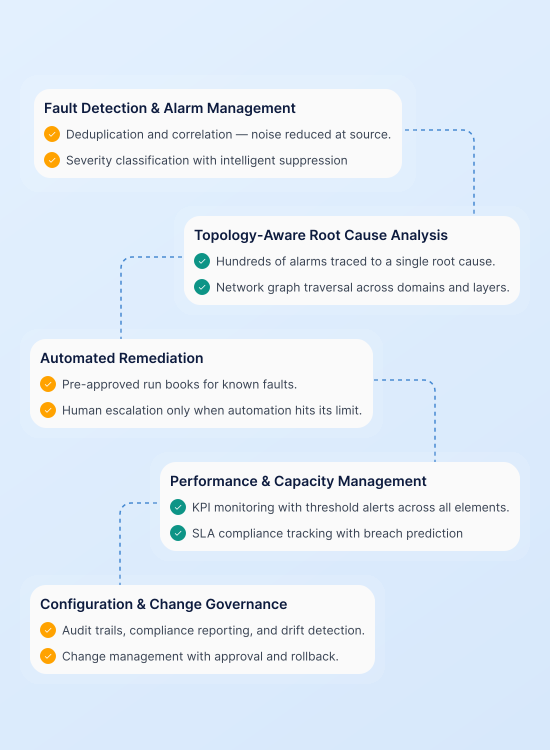
Five capabilities, all running on the abstraction above, all working the same way whether the alarm came from a Nokia radio or a Juniper router.
Alarm ingestion, deduplication and correlation
Across all domains and vendorsOne protocol-agnostic pipeline absorbs every alarm source in the estate, strips the duplicates, and groups what remains into incidents. The NOC works a queue of causes, not a feed of symptoms.
Topology-aware root cause analysis
Hundreds of alarms, one sourceBecause topology and inventory live in the same model as the alarms, the platform can follow the dependency chain rather than guess at it, and show the engineer the evidence path it followed.
Automated remediation
Pre-approved runbooksKnown fault types clear themselves through runbooks your engineers approved, inside a defined blast radius, with rollback on every action. Anything without a defined reversal stays advisory.
KPI monitoring and capacity forecasting
Adaptive, not staticBaselines learn each site’s own pattern instead of holding one threshold across a whole region, so a stadium on match day does not page anybody, and a genuine drift does.
Configuration management, compliance auditing and change governance
Provable, not assertedGolden configs enforced against the live estate, drift surfaced as it happens, and every change carrying a risk score, an impact radius and an audit record. When the regulator asks what changed and who approved it, the answer is a query, not a project.
One platform, fifteen-plus OEMs,
three network layers.
Figures from a pan-India optical backbone operated by a neutral infrastructure provider. IP-MPLS, DWDM optical transport and legacy switching, previously run through separate vendor element managers.
~60% alarm noise removed
On a Tier-1 mobile estate handling roughly 12.5 million alarms a day, through correlation and deduplication.
~50% faster MTTR
Across defined incident families, on the same deployment, measured against an agreed pre-deployment baseline.
~40% L1/L2 efficiency gain
Triage effort returned to the team, with 20 to 40% fewer incidents through proactive prediction.
Results measured on one operator's estate are not a forecast for yours. Every engagement starts by baselining your own numbers, so the comparison is honest on both sides.
Abstraction cuts both ways.
A layer that frees you from your OEMs is worth very little if it binds you to us instead. The same interfaces that make the platform vendor-agnostic are the ones that make it possible to leave.
Your data model, readable
Inventory, topology and history are queryable through open APIs. Nothing is held in a format only we can read.
Standards, not dialects
TM Forum APIs, 3GPP interfaces, NETCONF, SNMP, REST and Kafka. The integration surface is the industry’s, not ours.
No rip-and-replace to start
The platform sits over what you run today. Existing element managers keep working while the abstraction builds up underneath.
Where this hands off.
Build to Operate does not end at a boundary. Inventory, topology and service context carry straight through. Resource Management and the NOC run across all four stages, which is why nothing has to be re-keyed between them.
Plan to Build
Network rollout tracked in one workspace, from first site candidate to final acceptance.
Stage 03Operate to Acquire
Accurate capacity records mean sales checks serviceability against what exists.
Stage 04Issues to Resolve
Root cause analysis is only as good as the topology beneath it.
Name the vendor that keeps breaking your correlation.
We will show you what its output looks like once it has passed through the abstraction layer, and what your existing correlation rules would then see. If your topology and inventory data are not yet clean enough for that to work, we would rather tell you before you buy anything.
Worth a conversation
with your team?
Contact NetSingularityTell us where you're losing the most ground. We'll show you exactly where Netsingularity fits. And where it doesn't. A structured technical walkthrough on your use case, your data patterns.
Share the use case, team context, and email. We'll follow up with a focused walkthrough for your network lifecycle priorities.