No reconciliation layer.
A change in one module is the same fact in every other.
Platform overview
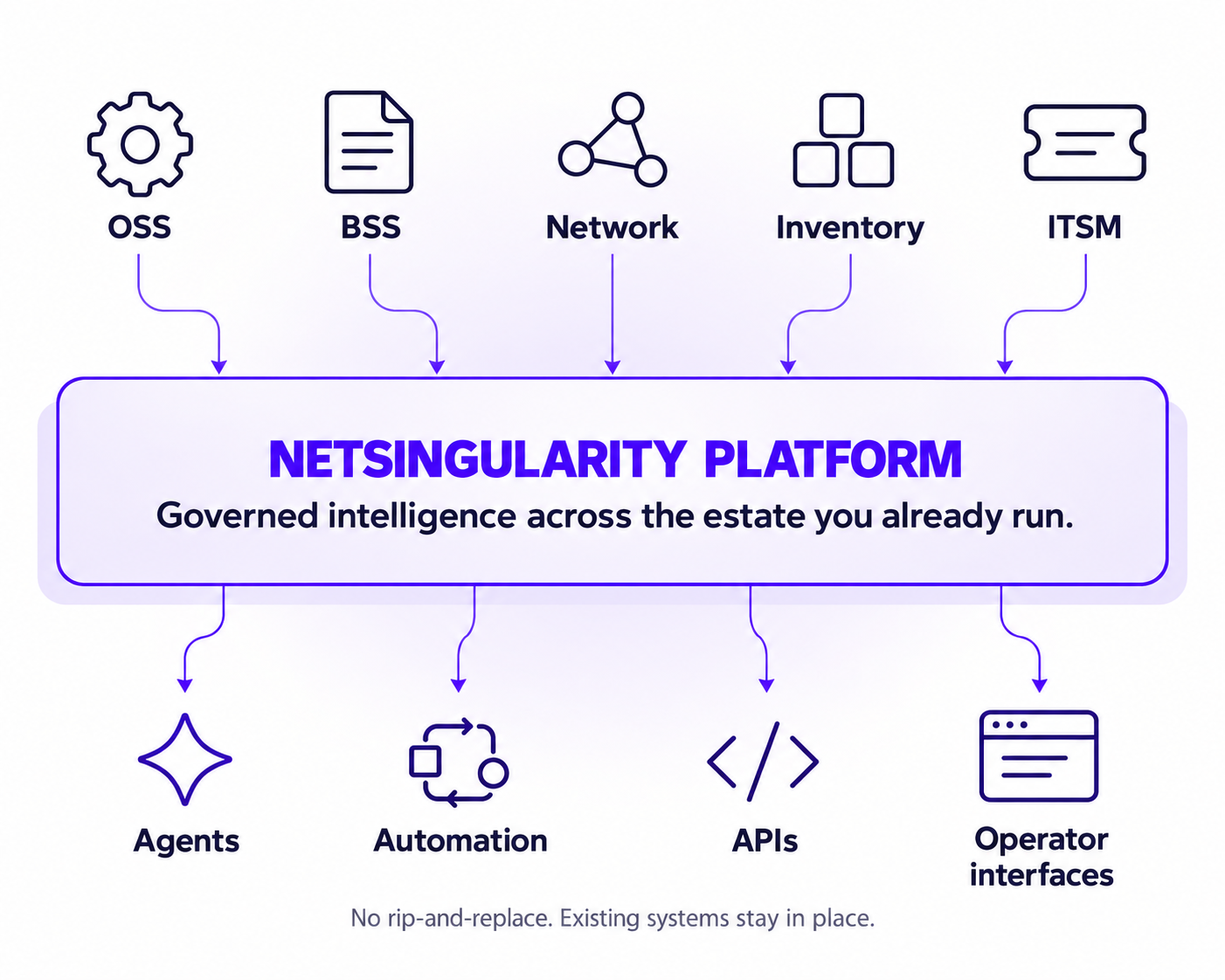
One shared operational platform across network, service and business operations. Every module, agent and workflow works from the same context — without replacing the systems you already run.
The platform foundation
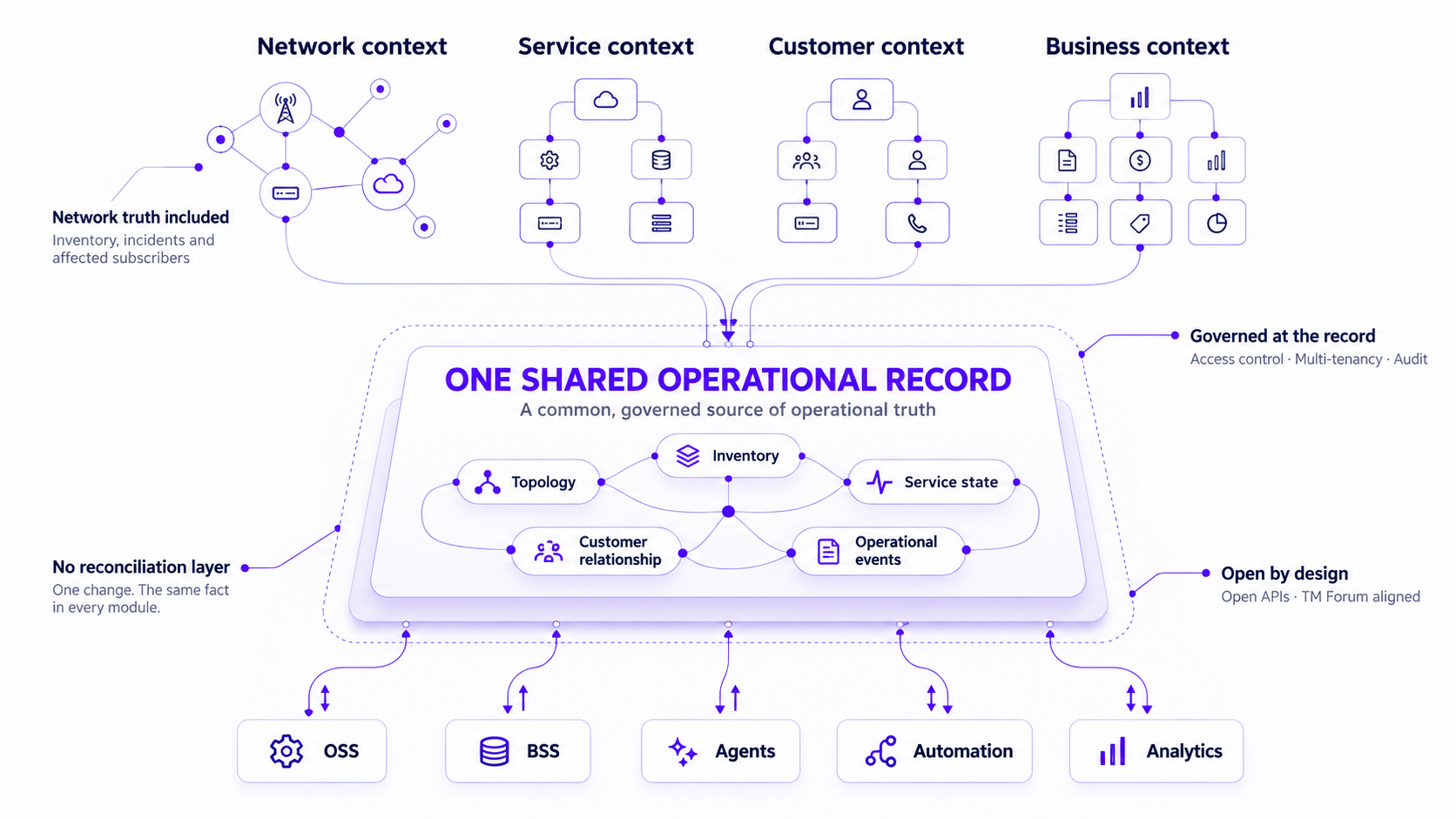
Not an integration layer stitching products together. One data model that every module was built on. A change in one module is the same fact in every other, so there is nothing to sync overnight.
A change in one module is the same fact in every other.
The model carries network inventory and incidents, so a fault knows which subscribers it touches.
Every object is addressable over open APIs, TM Forum aligned.
Access control, multi-tenancy and a full audit trail apply to the record, not to each application.
Siloed tools fragment your data and tax your budget every quarter. A built-in adapter & connector library onboards any node type or vendor, with no rip-and-replace.
Every legacy integration is an integration tax your operation pays every quarter, in license fees, SI retainers, and NOC hours. Convergence is how telco OpEx bends down in next quarter's P&L.
Network health, customer data and revenue live in separate systems. Nobody sees the full picture.
Decisions made on partial data cost more to reverse than they did to make.
Orders sit in queues while provisioning teams manually coordinate across systems. Activation takes days, not hours.
Every 24 hours of activation delay is revenue recognized by someone else.
NOC teams wade through thousands of correlated alarms daily. Real incidents are buried in noise.
Most NOC capacity goes to noise, not resolution. That's not an ops problem. It's a cost structure problem.
Capacity planning relies on instinct because the data that exists is in silos nobody can query in real time.
The most expensive decisions in telecom are the ones made without real-time data. You're making them daily.
Site acquisition, permitting, and construction managed in email and spreadsheets. Delays compound invisibly.
A one-week rollout delay on a 200-site program doesn't cost one week. It costs the cascade.
Billing disconnected from actual provisioning means services go live, but invoices don't always follow.
Industry estimates put BSS-related revenue leakage at 1 to 3% of total revenue. On a $500M operation, that's up to $15M walking out the door annually.
Real-time visibility across every site and team.
Delays surface before they compound. Projects stay on schedule and on budget.
AI agents in production today. Not next year.
Your competitors are already moving. This is how you move faster.
The problem today
What Netsingularity does
What that means for you
The problem today
Too many tools. No single view.
What Netsingularity does
One platform. One intelligence layer.
What that means for you
Every team sees the same data. Decisions stop being guesswork.
The problem today
Projects tracked in spreadsheets.
What Netsingularity does
Real-time visibility across every site and team.
What that means for you
Delays surface before they compound. Projects stay on schedule and on budget.
The problem today
Reactive alarms. NOC buried in noise.
What Netsingularity does
Closed-loop ops. Faults resolved before tickets open.
What that means for you
NOC shifts from noise to resolution. SLA breaches stop before they start.
The problem today
BSS and OSS working in silos
What Netsingularity does
Operations and revenue. One AI layer.
What that means for you
Revenue leakage closes. Provisioning and billing move in lockstep.
The problem today
AI still on the roadmap. Not in production.
What Netsingularity does
AI agents in production today. Not next year.
What that means for you
Your competitors are already moving. This is how you move faster.
Autonomous operations · Zero-touch / self-healing
Closed-loop automation detects, diagnoses and resolves faults before they reach a customer or open a ticket, zero-touch and under your governance.
↗ Signal in
No data left unread.
⚙ Agents decide
Domain-trained. Not generic.
✓ Loop closed
Every decision makes the next one smarter.
Field, NOC, commercial and service teams — along with automation and AI — work from the same live context, not separate copies of it.
That is not integration. That is convergence.
A natural language interface backed by a semantic network ontology. Purpose-built for network infrastructure, operations data, and the relationships between services, assets, customers, and incidents.
Network Intelligence
The BGP session drop on Core-PE-07 is affecting 3 enterprise accounts on MPLS circuits routed through that node. Automated failover is in progress with estimated restoration in 4-8 minutes.
Network Intelligence
SLA breach threshold for these 3 accounts is 60 minutes of unplanned downtime. At the 2h mark, estimated SLA credit exposure is increasing. Current downtime is 14 minutes.
NOC Engineer
“Which alarms on this node are linked to the core transport fault?”
Gets correlated fault chain with affected services in seconds. No tool switching.
Situational awarenessService Manager
“Which enterprise customers are at SLA risk in the next 2 hours?”
Gets live exposure view with breach probability and account names. Acts before the call comes in.
Proactive managementNetwork Planner
“Where will we hit capacity constraints in the next 90 days?”
Gets demand forecast mapped to topology. Investment decisions made on evidence, not instinct.
Forward planningCOO
“What was our network-related revenue impact this week?”
Gets a business-level answer drawn from live ops and billing data. No analyst report needed.
Executive visibilityBuild, tailor and own your solutions in the Studio. Your logic, your IP, open standards. No black boxes, no SI relationship for life.
Studio flexibility
Compose workflows, agents and policies, no black boxes.
Tailored to your needs
Solutions shaped to your topology and processes.
Own it independently
Your team custom-develops and runs it without us.
Your IP protected
What you build stays yours, no lock-in.
Go deeper
How vendor complexity becomes one shared operational model.
Explore ArchitectureHow agents act inside operator-defined authority.
Explore AI-Governed OperationsHow software moves from recommendation to completed operational work.
Explore Service as SoftwareHow platform, models and inference stay inside the operator perimeter.
Explore Air-Gapped AIBring the OSS, BSS, network systems and operational workflows you already have. We’ll show what stays, what connects, and where shared context and governed intelligence add value.