
Every fault, ticket and SLA breach tracked until the network is whole again.
When something goes wrong, resolution should not depend on who is online or which inbox holds the update. NetSingularity keeps every issue visible, assigned and moving, from first alert to verified close, with the root cause written down while the engineer who found it is still looking at it.
Most incidents are not solved slowly.
They are solved twice.
The expensive failure in incident management is not a long MTTR on a hard fault. It is the same fault recurring every month, diagnosed from scratch each time, because the last engineer who fixed it closed the ticket with the word “resolved” and moved on. The knowledge existed. It was never captured, so it never compounded.
Tickets logged by hand
A human reads an alarm, decides it matters, and types a ticket. Under load, that step is where incidents quietly go missing.
Priority set by whoever is free
Routing follows availability rather than fault type and location, so the right specialist sees it third rather than first.
Closure without evidence
No captured cause means no recurrence detection, no vendor accountability, and no answer when the regulator asks what happened.
First alert to verified close.
And the return path that stops it happening again.
Correlation decides what becomes a ticket, not a person. The SLA clock runs underneath the whole lifecycle rather than being checked at the end. And closure is where the learning is captured, which is the only reason recurrence detection has anything to work with.
What the stage actually delivers.
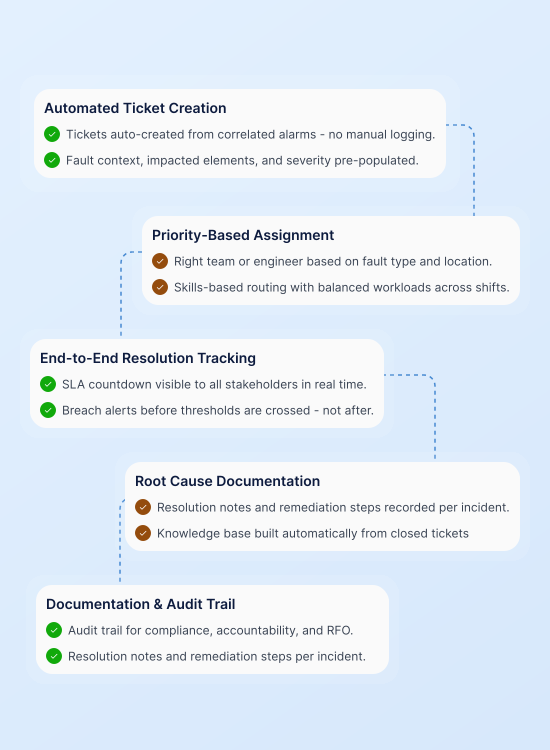
Automated ticket creation
From correlated alarmsTickets are raised from correlated incidents rather than typed by an engineer, so nothing depends on someone being awake and nothing is lost because the shift got busy.
Priority-based assignment
By fault type and locationRouting follows what the fault is and where it is, not who happens to be free, so the specialist who can close it sees it first rather than after two hops.
End-to-end resolution tracking
SLA countdown and breach alertsThe clock starts when the incident exists, runs visibly through every state, and raises a pre-breach alert with time left to act, rather than reporting the breach afterwards.
Root cause captured at close
While the engineer is still lookingCause and resolution notes are recorded as part of closing, not reconstructed at the post-incident review a fortnight later from three people’s memories.
Recurrence detection
Patterns surfaced automaticallyRepeat incidents are grouped and surfaced as a pattern, turning “we fix this every month” from tribal knowledge into a measured cost with an owner.
Post-incident audit trail
Compliance and vendor accountabilityA complete record of state changes, decisions and evidence. Usable for regulatory reporting, and usable in the conversation with an OEM whose equipment keeps failing.
The loop runs faster when
agents work inside it.
Every stage above can run with humans doing the work and the platform keeping the record. It runs considerably faster when the reasoning and the routine execution are handled by agents, under governance your engineers set, and can withdraw.
Sherlock
Reasoning agentDelivers root cause across topology, telemetry and change history in under two seconds, with the evidence path attached. That is what makes capture-at-close realistic rather than aspirational.
ProcBot
Action agentClears known fault types through pre-approved runbooks inside a defined blast radius, with rollback on every action. Anything without a defined reversal stays advisory.
NOC Copilot
Engineer’s agentLets L1 and L2 ask about live network state in plain language and get a sourced answer, instead of assembling one from four dashboards.
What operators got.
Figures from a Tier-1 Indian mobile operator running RAN fault management fully on-premises, across roughly 12.5 million alarms a day.
Under 2 seconds to root cause
Multi-hop fault chain tracing across domains, with every conclusion source-linked and auditable.
100% traceable
Every decision carries a transaction ID, with immutable audit logging and role-based access across the whole lifecycle.
Zero public-LLM dependency
Inference runs on the operator’s own GPUs. No alarm, topology or subscriber detail leaves the perimeter.
Results measured on one operator's estate are not a forecast for yours. The figures worth agreeing before anything is signed are your current alarm-to-incident ratio and your MTTR baseline.
Where this hands off.
Resolution quality is decided upstream. A diagnosis is only as good as the topology it reasons over, and that topology was created during rollout.
Plan to Build
Network rollout tracked in one workspace, from first site candidate to final acceptance.
Stage 02Build to Operate
The network goes live and the NOC inherits a topology it can trust.
Stage 03Operate to Acquire
Accurate capacity records mean sales checks serviceability against what exists.
Bring us last quarter's ticket export.
We will tell you your real alarm-to-incident ratio, how many of your tickets closed with no recorded cause, and which fault families you paid to diagnose more than three times. That last number is usually the one that changes the conversation.
Worth a conversation
with your team?
Contact NetSingularityTell us where you're losing the most ground. We'll show you exactly where Netsingularity fits. And where it doesn't. A structured technical walkthrough on your use case, your data patterns.
Share the use case, team context, and email. We'll follow up with a focused walkthrough for your network lifecycle priorities.