
From network capacity to recognised revenue. Without the handoff gap.
BSS capabilities connect directly to your network layer. Service activation is faster, billing matches what is actually provisioned rather than what was ordered, and your commercial teams quote from current data instead of a capacity export somebody pulled last quarter.
You are almost certainly billing
for a network you no longer have.
Industry analysts put telecom revenue leakage at 1 to 3% of total revenue. Almost none of it is fraud. It is the accumulated residue of services provisioned but never billed, services cancelled but still billing, orders that half-completed, and SLA credits calculated by hand from a spreadsheet. All of it caused by BSS and OSS holding different views of the same customer.
Provisioned, never billed
A service goes live at the network layer but the billing record never catches up. The customer is delighted. The margin is gone.
Half-completed orders
Multi-system provisioning is not transactional, so an order lands partially, voice active and data broken, and falls out of both systems’ reporting.
Quotes against stale capacity
Sales commits to a serviceability date derived from an inventory export. Delivery discovers the port is gone. The deal survives; the margin does not.
Three bridges between the network and the ledger.
That is the whole product.
The commercial chain across the top exists in every operator. So does the network layer along the bottom. What is usually missing are the vertical connections between them, and every one of the leaks above lives in a gap where a bridge should be.
What the stage actually delivers.
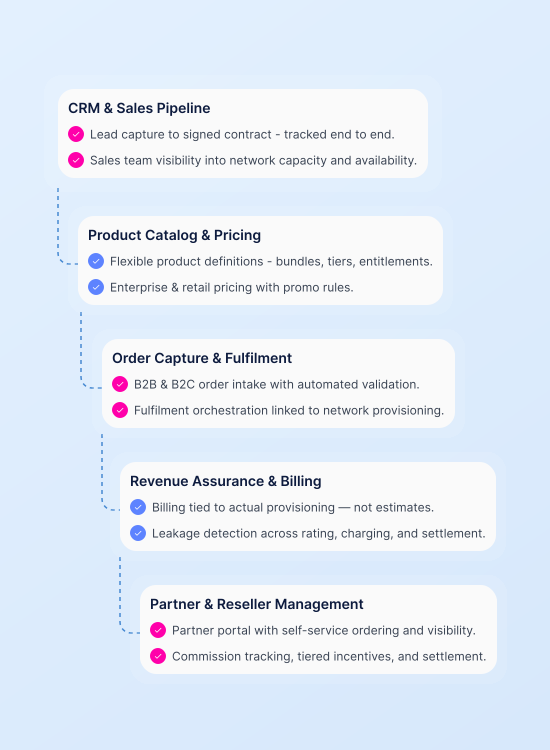
CRM and sales pipeline
Lead to signed contractOpportunity through to contract in one pipeline, with serviceability checked against live network capacity at quote time, so the date sales commits to is one delivery can meet.
Product catalog
Pricing, bundles, entitlementsFlexible pricing, bundles and entitlements for enterprise and retail in one catalog, so a new offer is a configuration rather than a release, and the same definition drives quoting, provisioning and billing.
Order capture and fulfilment
B2B and B2C, SLA-trackedOrders decompose into service orders automatically, execute transactionally across every core system, and roll back cleanly when a step fails. Fallout is detected rather than discovered.
Revenue assurance
Billing linked to actual servicesContinuous reconciliation across usage collection, rating, charging, billing and ledger, with provisioned-not-billed and billed-not-provisioned surfaced as exceptions rather than found at audit.
Partner and reseller management
Commission tracking and portal accessScoped portal access for franchises and resellers to onboard, activate and recharge in-store, with commission calculated from settled transactions. A channel becomes a scalable route to market instead of a queue of phone calls to head office.
What operators got.
Figures from a national mobile operator in the Caribbean, part of a major regional group, serving a multi-island territory through direct care agents and a nationwide franchise network.
100% audit coverage
Every provisioning change carries an identity, an approval and a transaction record, replacing shared credentials and no traceability.
~95% fewer inventory discrepancies
SIM inventory moved from conflicting spreadsheets to one governed supply chain with seven tracked lifecycle states.
100% franchise digitalisation
Stores moved off paper forms and phone calls to head office, onto scoped portal access with the same controls as direct agents.
Results measured on one operator's estate are not a forecast for yours. The number worth agreeing before anything is signed is your own current leakage rate.
Ask for the reconciliation, not the demo.
Revenue assurance is easy to promise and awkward to prove. The honest test is not a dashboard. It is running a reconciliation against your own data and seeing what falls out. If the answer is “almost nothing”, you have a well-run estate and you should spend the money elsewhere. We would rather find that out early too.
Provisioned, not billed
Count the live services in the network with no corresponding active billing record. This is usually the largest bucket.
Billed, not provisioned
The reverse, and the one that becomes a refund exposure and a regulatory problem rather than a margin one.
Order fallout
Orders that reached partial completion and stopped, invisible to both systems because neither owns the whole transaction.
Where this hands off.
Commercial state is only as trustworthy as the network record beneath it. That dependency runs backwards through the whole lifecycle.
Give us one month of billing and one inventory export.
We will reconcile them and tell you how many live services have no billing record, how many billing records have no live service, and how many orders stopped halfway. That number is the business case, and it is yours whether or not you buy anything.
Worth a conversation
with your team?
Contact NetSingularityTell us where you're losing the most ground. We'll show you exactly where Netsingularity fits. And where it doesn't. A structured technical walkthrough on your use case, your data patterns.
Share the use case, team context, and email. We'll follow up with a focused walkthrough for your network lifecycle priorities.