
Architecture

Carrier-grade. Cloud-native.Production-proven.

A shared telecom architecture that abstracts vendor complexity, gives every operational domain the same context, and runs on the infrastructure you control.

99.99%
Availability SLA with primary-secondary site resilience
TM Forum API Compliant
Open APIs aligned to TM Forum standards for integration with existing OSS/BSS ecosystems
Enterprise Security
SSO, RBAC, vault-based secrets management, data encryption at rest and in transit
SOC 2 Type II & GDPR Alignment
Audit trail, access governance and data-residency controls for regulated environments

The architecture

One architecture, from vendor equipmentto operator outcomes.

Vendor-specific systems remain below. A shared context and platform make services consistent above them.
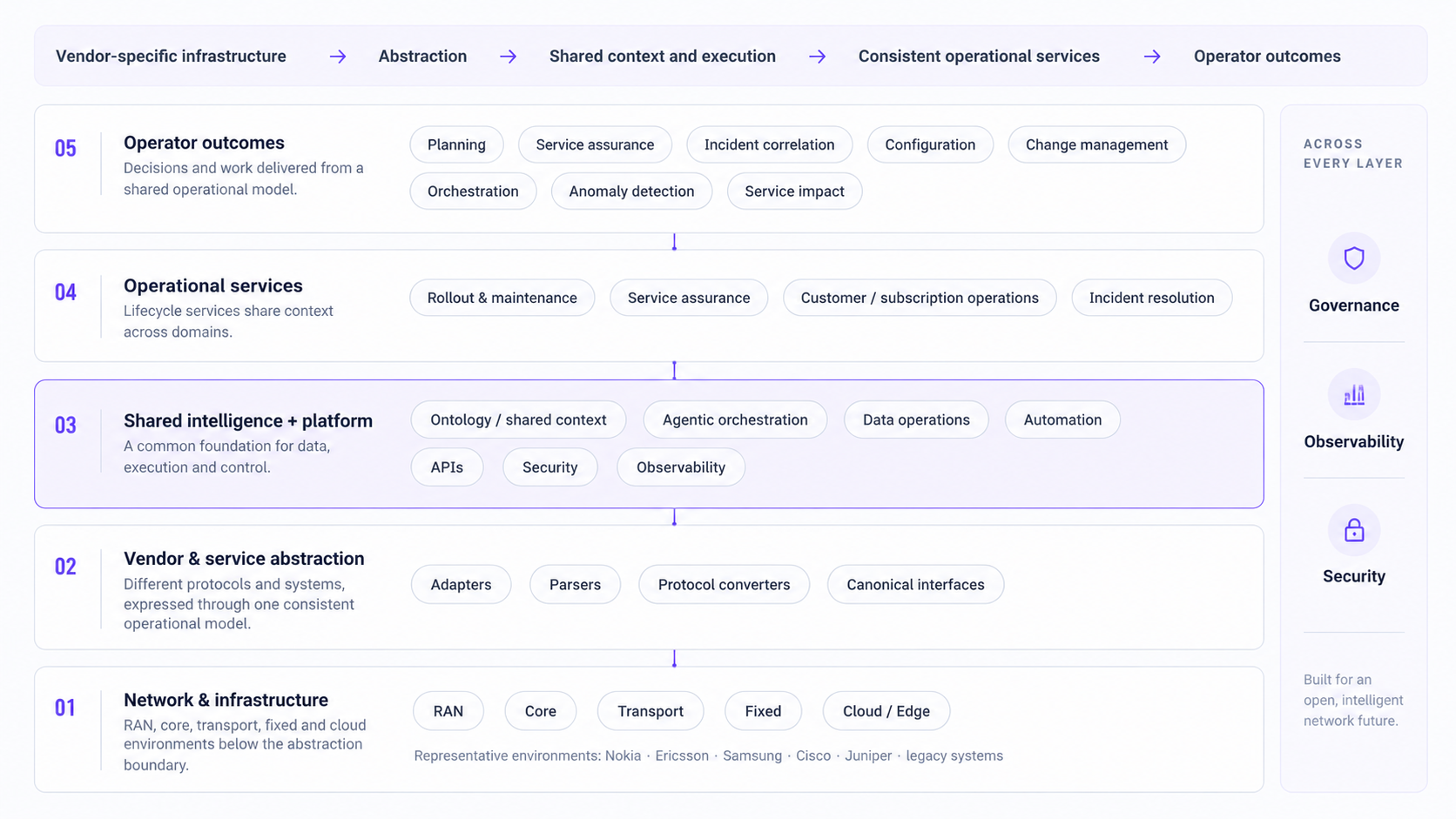
NetSingularity layered architecture from network infrastructure and vendor abstraction through shared intelligence, operational services and operator outcomes, with governance, observability and security across every layer.

The abstraction boundary

Vendor changes below.Operations stay consistent above.

Adapters and protocol handling isolate vendor-specific implementation. Shared services work from a consistent operational model instead of being rebuilt for each system.
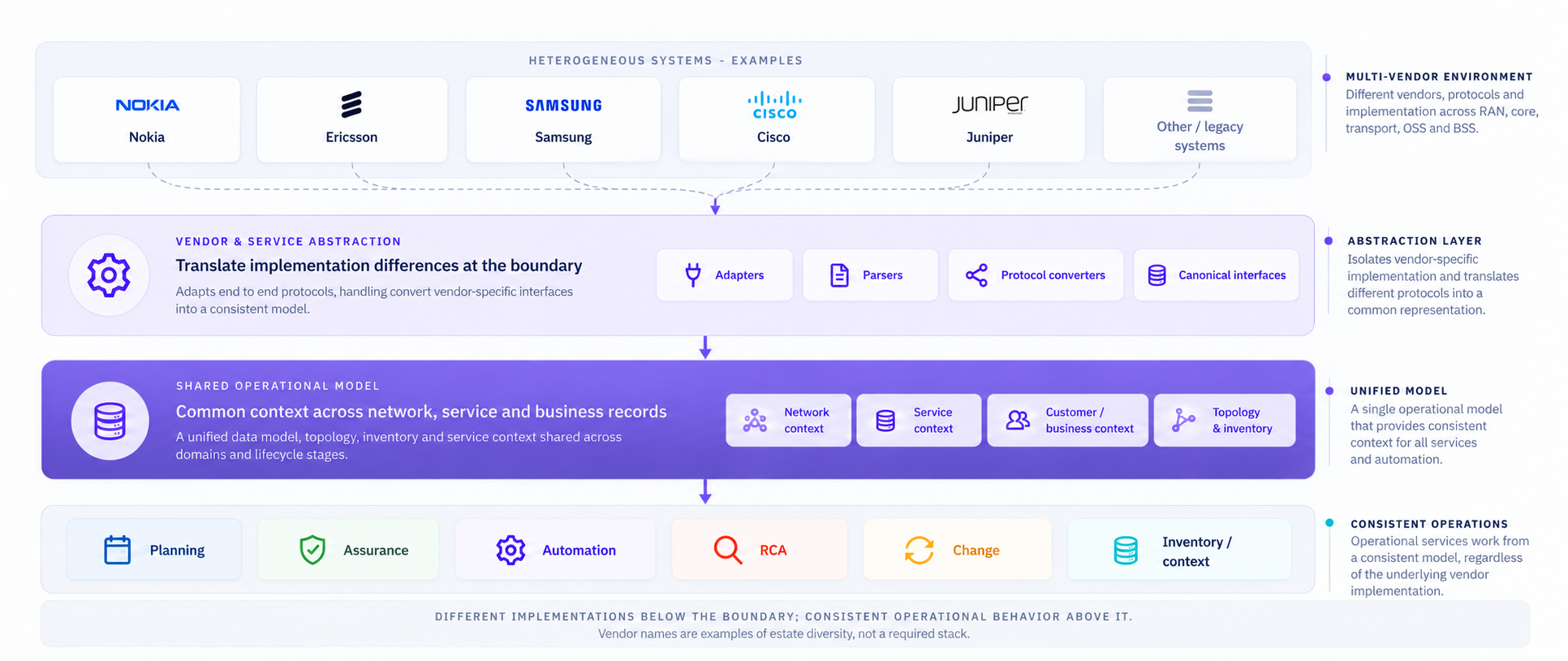
Multi-vendor telecom systems normalized through adapters, parsers, protocol converters and canonical interfaces into a shared operational model supporting planning, assurance, automation, RCA, change and inventory.

Shared platform

One shared platform.Not another set of integrated silos.

  1. 01

    Context

    • Ontology
    • Shared operational record
    • Topology
    • Inventory
    • Business / customer context
  2. 02

    Execution

    • Agentic orchestration
    • Workflows
    • Automation
    • Procedures / MOPs
  3. 03

    Platform

    • Data operations
    • APIs
    • Platform services
    • Provisioning / integration
  4. 04

    Control

    • Security
    • Policy
    • RBAC / identity
    • Audit
    • Observability

Engineering foundations

Built to run. Built to connect.Built to govern.

Deploy anywhere

Deploy on any cloud or on-premises. Containers scale elastically with no infrastructure over-provisioning.

Microservices architecture

Independently deployable modules. Failures stay isolated. Updates deploy without full-platform downtime.

API-first platform

Every capability accessible via REST API. Pre-built adapters for common OSS, BSS and NMS integrations.

Multi-tenancy

Serve multiple operators or business units from one platform with full data and process isolation.

High availability design

Primary-secondary site topology, no single point of failure, and self-healing service recovery.

No-code configuration

Workflows, product catalogs, KPI definitions and business rules managed by your teams, not developers.

Near real-time data platform

Governed platform for ingestion, transformation, ML, APIs and operations, built together.

Zero-trust security model

Every service-to-service call authenticated. Vault for secrets. No lateral movement by design.

Domain reach

Built across telecom domains,not around one vendor stack.

  • RAN
  • Core
  • Transport
  • Fixed / FTTH
  • Cloud / Edge
  • OSS
  • BSS

Why the architecture matters

The abstraction is technical.The outcome is operational.

Multi-vendor

One abstraction over heterogeneous network estates.

Cross-domain

Context moves across RAN, core, transport, OSS and BSS.

Closed-loop

Actions return to a verified operational state.

Unified lifecycle

Operational context carries from planning through operations.

Deployment option

The same architecture can stayinside your perimeter.

Run platform services, operational data, models and inference within the operator-controlled environment.

  • Zero runtime egress
  • Local inference
  • Signed offline updates
Explore Air-Gapped AI
Architecture review

Bring your architectureconstraints.

Show us the OSS, BSS, network systems and infrastructure you already run. We’ll map what stays, where abstraction belongs, and where intelligence can sit.

Discuss your architecture